



 ไทย
ไทย
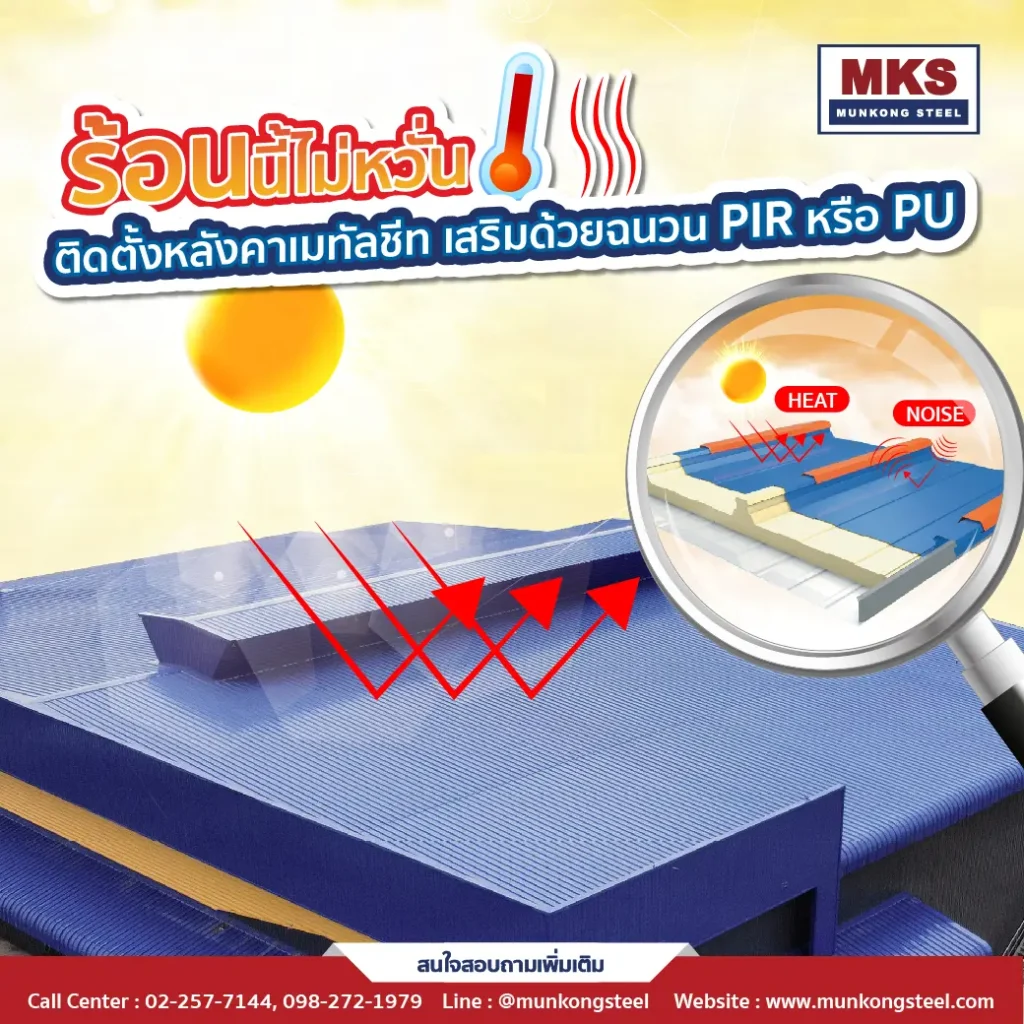
Heat is a major concern for factory buildings, especially when solar heat is transferred directly through the roof into the building. Choosing Metal Sheet Roofing with PIR Insulation or PU insulation is an effective solution for improving thermal performance while enhancing the safety of factory buildings.
Today, MKS introduces Metal Sheet Roofing with PIR and PU Insulation, explaining what these insulation materials are, their key benefits, and the differences between PIR and PU insulation.
What Is Metal Sheet Roofing with PIR and PU Insulation?
Metal Sheet Roofing is already known for its strength, durability, and ease of installation. Adding PIR or PU thermal insulation further improves the overall performance of roofing systems for factories and industrial buildings.
The insulation helps reduce heat transfer through the roof into the building, minimizing the impact of external heat on indoor temperatures. In addition, choosing PIR insulation can provide improved fire performance, helping reduce the risk and potential damage caused by fire.
What Are PIR Foam and PU Foam Insulation?
PIR Foam (Polyisocyanurate) and PU Foam (Polyurethane) are thermal insulation materials suitable for roofing applications.
Both types of insulation produced by MKS feature a Closed Cell structure, providing strength, lightweight performance, and low water absorption, together with excellent thermal insulation properties.
MKS PIR and PU insulation have a K-Value of 0.023 W/m·K. Compared with other insulation materials of the same thickness, their thermal performance helps reduce heat transfer from sunlight through the roof and into the factory.
As a result, Metal Sheet Roofing with PIR or PU Insulation can help reduce heat inside factory and industrial buildings.
Both types of MKS insulation are also designed for a service life of more than 30 years, providing reliable long-term insulation performance.
What Is the Difference Between PIR and PU Insulation?
One of the key differences between PIR Foam and PU Foam is their performance when exposed to fire.
PIR insulation provides greater resistance to flame spread than PU insulation. When PIR is exposed to fire, the surface of the insulation forms a black char layer, which helps slow the spread of flames to surrounding materials.
This characteristic can help reduce the risk and potential damage caused by fire in factories and industrial buildings.
Metal Sheet Roofing with PIR Insulation and FM Approval 4471
MKS Metal Sheet Roofing with PIR Insulation has been tested for safety and the reduction of fire-related loss risks in accordance with the internationally recognized FM Approval 4471 standard.
This makes PIR insulated metal roofing a suitable solution for factory and industrial buildings that require both effective thermal insulation and enhanced fire safety performance.
Why Choose Metal Sheet Roofing with PIR or PU Insulation for Factory Buildings?
Metal Sheet Roofing with PIR or PU Insulation provides several benefits for factory buildings, including reduced heat transfer, lightweight construction, low water absorption, and a long service life.
For applications where enhanced fire performance is required, PIR insulation also offers additional benefits by helping slow the spread of flames.
For business owners planning to install a new factory roof or renovate an existing roofing system, MKS can provide advice on selecting the appropriate Metal Sheet Roofing and thermal insulation solution based on the specific requirements of each building.
MKS is ready to help reduce heat and enhance the safety of your factory building.